How did JS Wright & Sons start exporting to India and Pakistan?

In 1914 J.S. Wright & Sons Ltd. began dealing with a cricket bat manufacturer named Symonds in Allahabad, India. The company was a strong, well-known brand back then that used the white rhino as its logo. JSW then saw an opening for selling English Cricket Bat Willow clefts to other manufacturers in India. This was already being done by one other supplier, but Carleton and Nicholas Wright of JSW were very keen to expand.
Entering a crowded market
One issue for JSW was that the bat makers in India were quite happy with both the product and price of their competitors, and were therefore not ready to change to a new supplier. This was until 1979 when JSW visited Sareen Sports in Meerut and gave Mr Narinder Sareen the chance to try their clefts. This prompted an order of 200 units, and a few small orders from Meerut and Jalandhar followed. Nowadays, Sareen Sports is one of J.S. Wright’s two biggest customers.

Workers at a bat making factory in India (February 1995)
In early 1982, Nicholas Wright visited India to assess the market. He visited every bat maker in Jalandhar, Meerut, and Allahabad, and business gradually started growing in the region.
Sanspareils Greenlands, the then leaders of the bat making industry in India and one of the largest bat makers in the world today, were then introduced to JSW. Greenlands placed their first ever order for 500 clefts, grade 1 and 2, in early 1984. They are estimated to have started making English Willow cricket bats in 1983, and are one of JSW’s biggest customers today.
Branching into Pakistan
While the Indian market was growing slowly, the same was happening in neighbouring Pakistan where JSW also started visiting. It was less complicated in Pakistan as there were fewer companies to deal with and the importation process was very easy. CA Sports were JSW’s first customer in the country, and today they are our largest customer in Pakistan.

A cricket bat factory in the Pakistani city of Sialkot, photographed by Jeremy during one of his visits (February 1995)
Anticipating an increase in demand, Carleton and Nick increased production of clefts and oversaw the planting of approximately 20,000 trees each year in expectation of future demand. By the year 1990, JSW’s market share of the English Willow industry in India and Pakistan was very good and, while this has since dropped slightly following the emergence of new suppliers, we are now heading for 35,000 trees planted per annum and business is very good on the sub-continent.
Representation on the sub-continent
These days J S Wright & Sons represent themselves in India and Pakistan with communication and travel far easier than it was, before that they were represented in India by Anmol Gupta of Anmol Overseas Agencies and before that Hardwood Dimensions Limited in Manchester represented them in India and Pakistan. Jeremy travels to India every year with a few Indian customers also travelling to the UK from India, most Pakistani customers travel to the UK at least twice a year so Jeremy doesn’t visit there currently, although he has visited many times before.
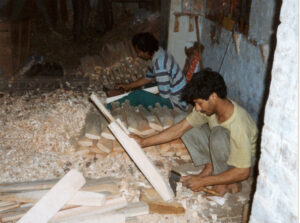
Cricket bats being made by hand in India (February 1995)
The Pakistan market continues to grow but not as fast as India, there are still less world renowned cricket bat makers in Pakistan, this is partly due to the political unrest especially between Pakistan and India.
We feel proud that we have been supplying to all of the world renowned cricket bat makers in India for the past 30 years, and much of this is due to the travelling of Carleton and Nick Wright in the early 1970s, as well as our director, Jeremy, who has visited every year since 1994 (with the exception of the Covid-19 interruption).