How do you determine if an English Cricket Bat Willow tree is ready for harvest?
One of the most common questions we get asked by landowners is ‘how will I know when my willow trees are ready to be felled?’. So we have produced a handy guide to answer this question – and others around the size of willow trees.
The Golden Rule – circumference not just age
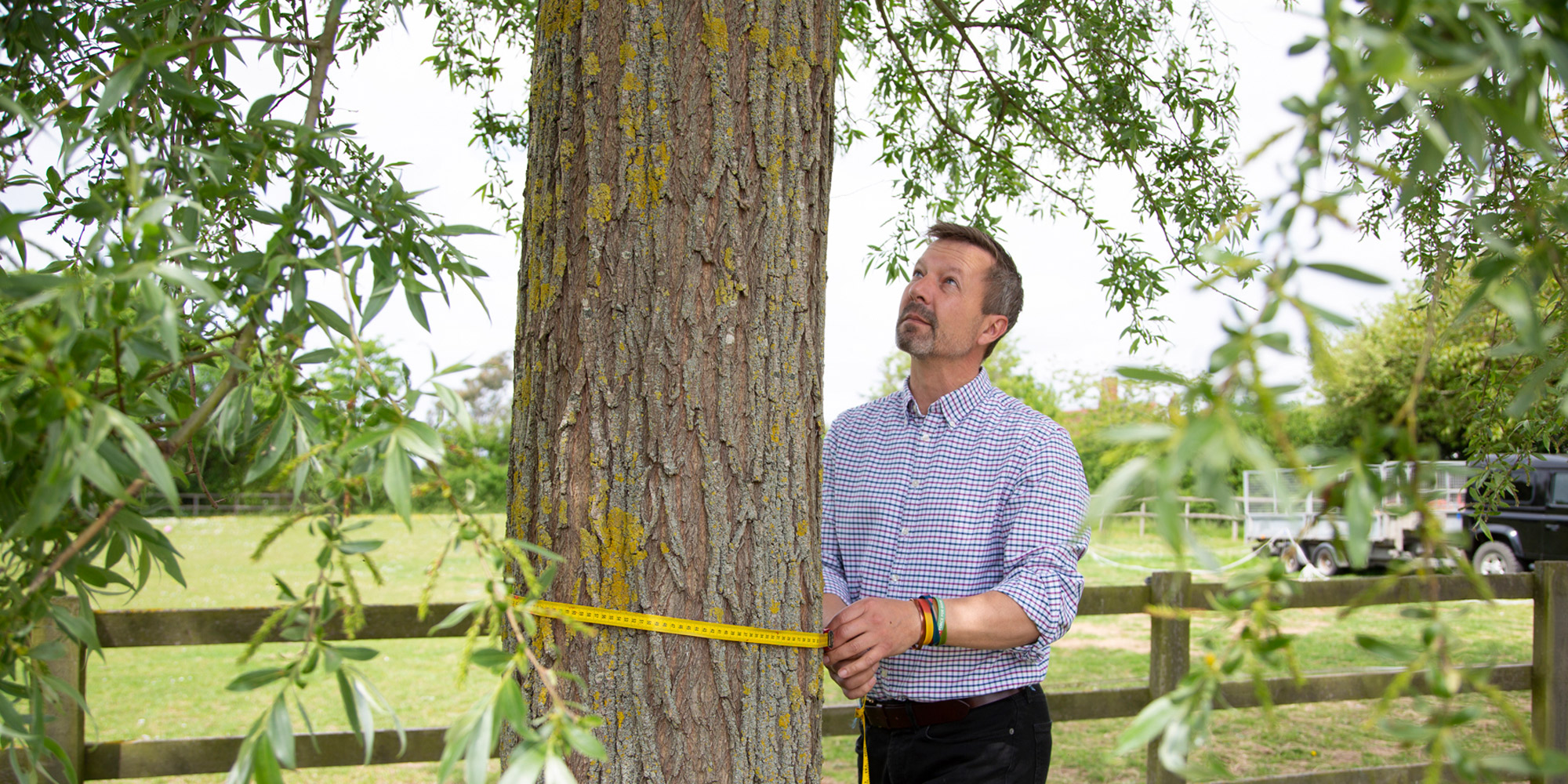
When it comes to Salix alba var. caerulea (English Cricket Bat Willow), size matters. While most trees take between 12 to 20 years to reach maturity, we don’t rely solely on a calendar, we get the tape measure out. The ideal target for a fully mature tree is a 58-inch / 147cm circumference measured at standard forestry breast height (approx. 4ft 4in / 1.3m from the ground), with a clean, branch-free trunk up to 10 ft / 3m before the main crown splits out. This allows us to cross-cut the trunk into four full-sized 28-inch cleft logs.
Smaller or single-log trees: You don’t always need a 10-foot trunk for a tree to be worth harvesting. If viable, we will fell trees yielding clean timber from 28 inches (one bat length) upwards—ensuring landowners get full value from every viable willow on their land.
Why 58 inches? That specific girth allows us to cross-cut the trunk into three or four 28-inch logs, which are then split into 38 to 40 individual clefts (the raw wooden blocks shaped into bats). If the tree is too small, you won’t get enough clefts out of it to make felling worthwhile.
Are there other signs that my willow is ready?
Beyond the measuring tape, there are a few visual clues that tell you a tree is primed and ready to be felled.
Clean, straight timber: A prime tree has a straight, unblemished trunk without big knot-holes, heavy side-branches or severe scarring. Regular pruning during its young life keeps the bark smooth and knot-free.
Bark pattern: As the tree matures, its smooth greyish bark begins to form shallow, diamond-like vertical ridges.
Pest & rot free: Healthy willow leaves are bright and the trunk shows no signs of heavy rot, decay or significant insect damage.
Why you shouldn’t wait too long…
While it is tempting to think that higher than 58 inches must surely be better, this is not necessarily the case. When an English Willow reaches its ideal size, it actually hits a bit of a race against time. Over-mature trees become vulnerable to heart-rot and degrading timber. It is also of greater danger to the elements, whether wind damage or a severe storm which can easily snap an overripe willow, turning top-grade cricket bat timber into firewood overnight. As soon as your tree hits that magic 58-inch mark, harvesting it ensures you get top market value before nature takes a toll.
Think your willow trees might be ready?
Determining timber quality and exact log yields requires an experienced eye. Rather than struggling with a tape measure, let our team carry out a free, no-obligation on-site assessment. We will visit your land, inspect your standing timber, and provide an accurate valuation. From Forestry Commission felling licences to timber extraction and free replanting, JS Wright & Sons handles the entire process from start to finish. Our specialised felling teams leave your land clean, tidy and protected. And for every mature tree we harvest, we replant for free – setting up your land for the next generation.
Contact us today on 01245 361639 to arrange your free site visit.
For more information visit our Trees Nearing Maturity? website page.