A day in the life of a feller
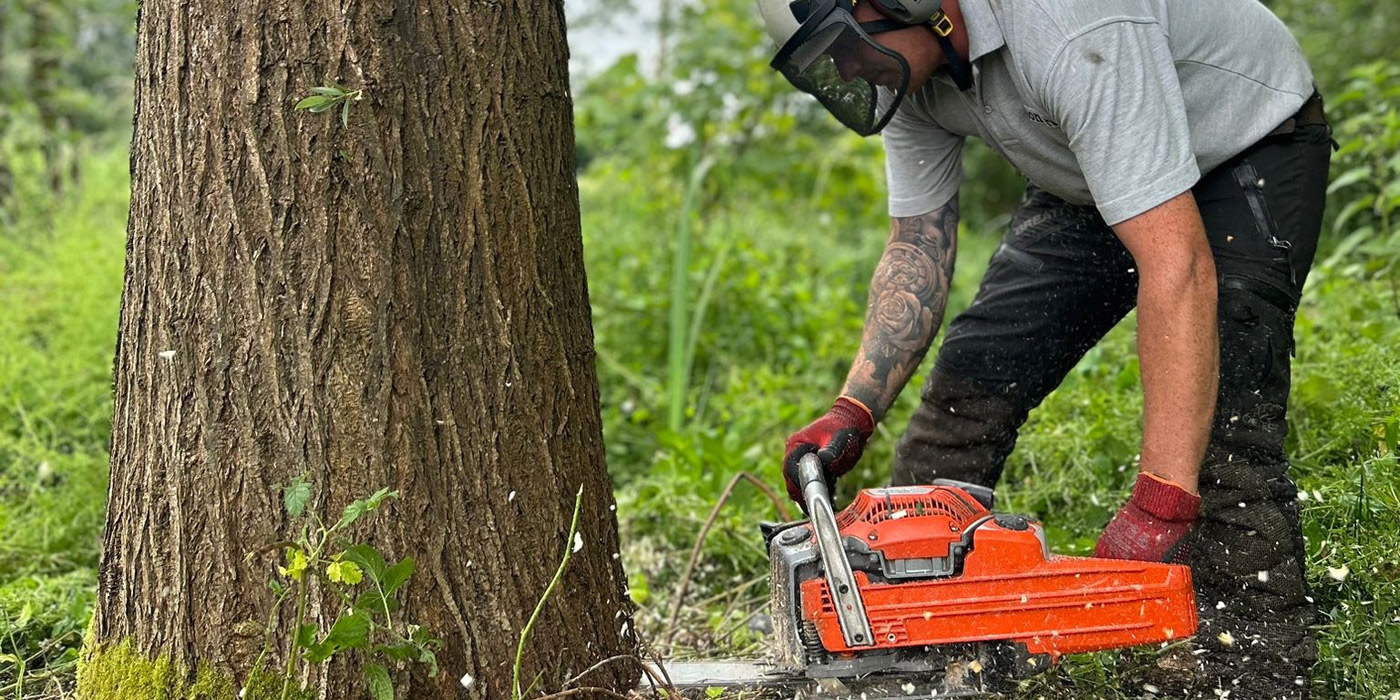
As the world’s largest and oldest established company supplying English Cricket Bat Willow, we plant more than 30,000 trees each year on average.
Last year, we planted approximately 32,000 of the straightest willow sets across the country, providing landowners with a strong investment for the future.
We also felled around 9,000 trees last year, providing customers not only with good prices but also with the best service in the industry.
But how exactly do our felling teams work? Colin Gwynn, who spent more than 20 years as a feller for JS Wright before moving to a different role within the company, explains all.
Starting out in the industry
“I first got involved with JS Wright when I was around 15-years-old,” he explains.
“I was at school and looking for a bit of pocket money and came across a chap doing some felling in our village.
“I asked if he needed help picking up sticks and clearing up, and he agreed. It progressed from there, and by the time I was 16 he offered me a full-time job.”
During his long career as a feller, Colin worked on hundreds of different sites across the country, making sure that each job was completed to the very highest standards.
But what exactly does a day as a feller entail? Here, Colin guides us through the processes that our teams undertake.
A day in the life
“We would aim to arrive on site first thing in the morning, and the most important thing is that your saw has been sorted the evening before and is very sharp.
“The first thing to assess when we arrive on site is the weather. We obviously look at the trees straight away, but the one thing that can ruin a day’s felling is the wind.
“If it’s too windy then we can’t begin work, so we would always try to get as many trees as possible down during the days with good weather, so that we could then work on clearing up and removing the fallen trees on a windier day.”
“It’s also important to carry out safety checks. You’re looking for things like wires or cables overhead that could cause an obstruction when you’re felling.
“There could also be nests in the tree, so that is something to look out for, and we also need to be aware of where our escape route is in case something were to go wrong.”
The felling begins
“Once a clear workspace has been created and safety checks completed, the felling can begin; there is a particular technique to this and it is something that Colin has mastered over the course of his career.
The methods that we use have been refined over generations and have evolved in tandem with advances in the technology and equipment available to us.
“Once the tree is felled we would then establish a working area and pull each tree individually to that area.
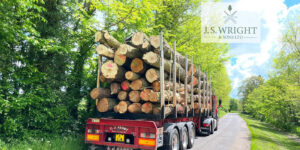
“All of the useable timber would be stacked separately on the roadside for the lorry to collect shortly after, but any rubbish that can’t be recycled is burned under a D7 agreement, which is from the Environment Agency and gives us permission to do so.”
Making a good first impression…and leaving an even better one
“We always ensure that the customer’s land is left exactly how we found it. We pride ourselves on the idea that customers wouldn’t even know we had ever been.”
While advances in technology may have made their job less labour-intensive, our fellers now work in larger teams than before, which allows them to operate more efficiently.
“We used to work in teams of two with one tractor, but as the machinery improved it became apparent that we needed more people on site to operate the equipment and that allows us to work far quicker and more efficiently than we did before.”
Operating across the country
“We often work away from home for extended periods of time as we work nationwide.”
“Last year, for example, I spent 22 weeks away from home and that wasn’t uncommon.”
“I spent 24 years in my previous role but had been felling for around 35, and I enjoyed every minute right up until I stopped and switched roles.”