A guide to trimming English Cricket Bat Willow

When growing English Cricket Bat Willow (Salix alba var. caerulea), planting the set is the first step, but the true value of the timber is forged in the years that follow. Unlike standard forestry, where trees are often left to grow naturally, cricket bat willow requires active management. The most critical management task is trimming.
How does trimming dictate timber value?
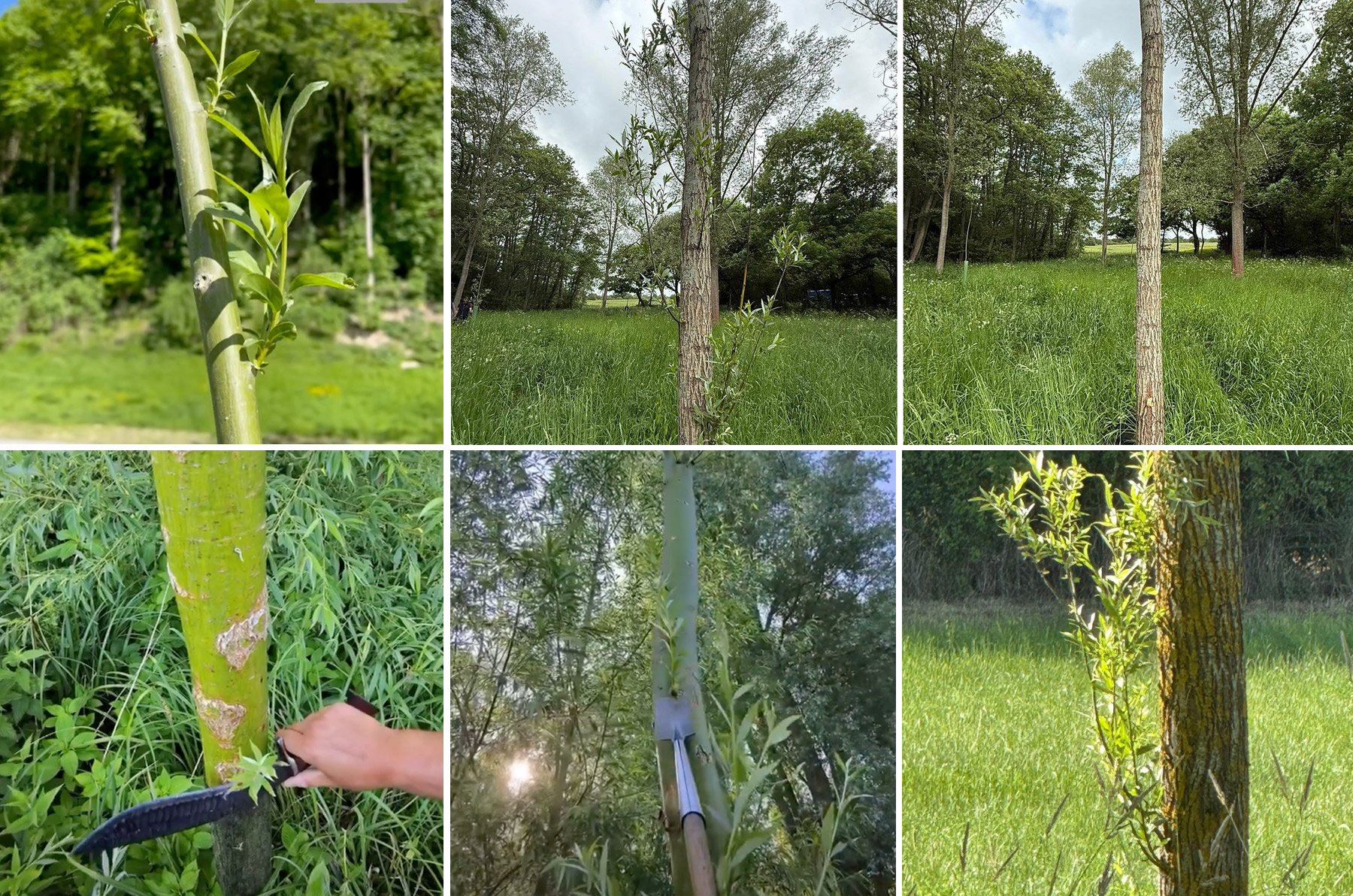
The goal of cultivating willow is to produce unblemished, straight, knot-free timber. When a young willow tree creates side shoots, they pull nutrients away from vertical growth. If those shoots are allowed to grow woody, they create knots that embed deep into the heartwood. Regular trimming forces the tree’s energy upward, encouraging a straight trunk while allowing the bark to cleanly occlude (heal over) where buds were removed.
Why do knots devalue English Cricket Bat Willow timber?
When a bat faces a cricket ball traveling at speed, it needs to absorb energy and rebound. While the straight grain of English Cricket Bat Willow acts like a series of natural shock absorbers, knots are believed to disrupt that process and create a stress point, which in theory makes the finished bat more susceptible to splitting under pressure. The truth, of course, is more nuanced (our stance has always been minor imperfections offer superb performance value), but the commercial reality is unarguable: players generally want a bat that looks pristine. Therefore, allowing a pattern of unchecked knotting to develop across a trunk will downgrade the tree’s value, reducing your return on investment at harvest.
How often should English Cricket Bat Willow be trimmed?
Willow grows at an astonishing rate, meaning maintenance cannot be a once-a-year afterthought.
How soon to start: New sets must be inspected and trimmed in their very first season.
Frequency: Trimming must be carried out at least twice a year. If you miss even a single year, the side shoots will harden, and damage to the timber grade is already done.
The best time of year: Trimming is best done during the active growing season, once in the spring/early summer to catch the first flush of growth, and again in late summer/early autumn before the tree goes dormant for winter.
How do you trim English Cricket Bat Willow correctly?
How you remove a shoot is as important as when you remove it. Careless pruning can scar the bark, causing rot or staining that devalues the crop just as badly as a knot.
The height: The objective is to maintain a clear trunk up to a height of 3 metres (approx. 11 feet). Once the tree has a clean 3-metre barrel, the canopy can be allowed to form its crown naturally.
The pro tool: We advise using sharpened, long-reach trimming blade, with a slight curve away from the tree to ensures a flush cut to the shoot while minimising risk of damage to bark.
The technique: Shoots should be trimmed flush with the trunk with a swift, upward movement. Young, soft, green buds can be simply rubbed off by hand, but thicker shoots but be trimmed to avoid damage to bark.
What to do with deer guards during trimming?
For young sets, deer guards and plastic tree shelters are essential to prevent wildlife from stripping the lower bark. During trimming, it is important these guards are checked and cleared of internal debris. They must be temporarily taken off so shoots growing inside can be trimmed, before being replaced and adjusted to ensure they aren’t restricting the expanding trunk.
The rewards of English Cricket Bat Willow stewardship
Maintaining a clean 3-metre trunk is a commitment, but many landowners and estate managers tell us a quiet morning in the fields tending to their investment is a rewarding part of rural stewardship. It requires no heavy machinery or complex labour, just a sharp blade, keen eye, and modest time commitment twice a year.